Google loves RGraph!!
Written by Richard Heyes, RGraph author, on 10th November 2026Did you know? Despite the awful ranking in the search results - Google loves RGraph really!
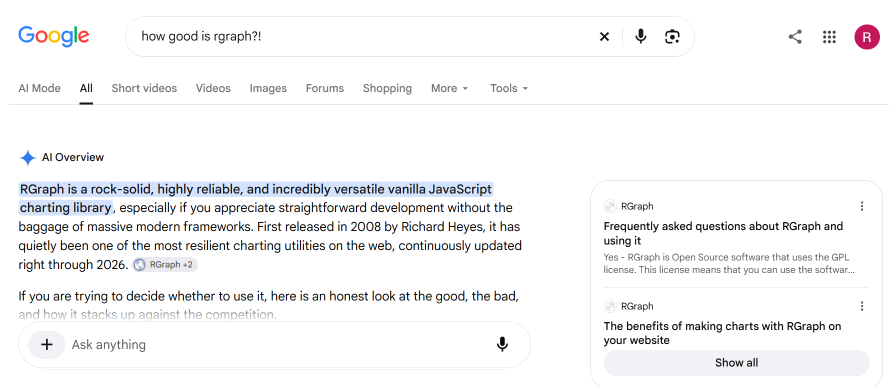
Did you know - Google loves RGraph really! This is how Google describes RGraph:
“
RGraph is a rock-solid, highly reliable, and incredibly versatile vanilla JavaScript charting library, especially if you appreciate straightforward development without the baggage of massive modern frameworks. First released in 2008 by Richard Heyes, it has quietly been one of the most resilient charting utilities on the web, continuously updated right through 2026.
Well, thank you Google!. OK, sure it was just AI generated - but it sure sounds real nice doesn't it!
The Strengths (Why it's good)
- Dual Rendering Engine (Canvas & SVG): Unlike libraries that force you to choose one or the other, RGraph supports both HTML5 Canvas and SVG rendering architectures. You can use Canvas for high-performance, data-dense, or highly animated rendering, and SVG for sharp vector scaling and easier DOM manipulation.
- Massive Variety of Charts: Out of the box, it supports over 60 responsive chart types. Beyond basic bars, lines, and pies, it includes specialized options like radar charts, meters, gauges, and newly introduced dumbbell variants.
- Zero Dependencies: It is written in native JavaScript. You don't need to load heavy frameworks like jQuery or massive data-binding libraries to use it.
- Modern Display Support: The library actively updates. Version 7.0 overhauled its canvas engine to support high-definition resolution rendering, making charts look incredibly sharp on modern Retina and 4K displays.
- Flexible Licensing: It is free and open-source under the GPL license for personal and general use. If GPL compliance doesn't fit your company profile, they offer a highly affordable commercial license.
- Traditional Imperative Configuration: RGraph relies on a more traditional, native JavaScript initialization and option-object configuration pattern. If you are working deeply inside component-driven, declarative frameworks like React, Vue, or Svelte, it won’t feel as seamless as a framework-native wrapper library.
- GPL Copyleft Constraints: Because it defaults to the GPLv2 license, if you modify the library or integrate it into proprietary software that you distribute, you are bound by copyleft terms (unless you purchase their commercial license).
- Smaller Community Ecosystem: While widely used—even trusted inside corporate platforms like Salesforce's mobile dashboards—its community ecosystem on platforms like GitHub is smaller compared to industry giants like Chart.js or D3.
RGraph is excellent if you need client-side speed, lightweight footprint, and crisp rendering options across both Canvas and SVG. It has survived nearly two decades of web evolution because it is robust, easy to configure, and light on server load. However, if your application is deeply tied to modern frontend frameworks or requires ultra-modern UI trends out-of-the-box, other options might require less boilerplate glue.”
And here's the proof (as if you needed it...!):
Last modified: 10th November 2026